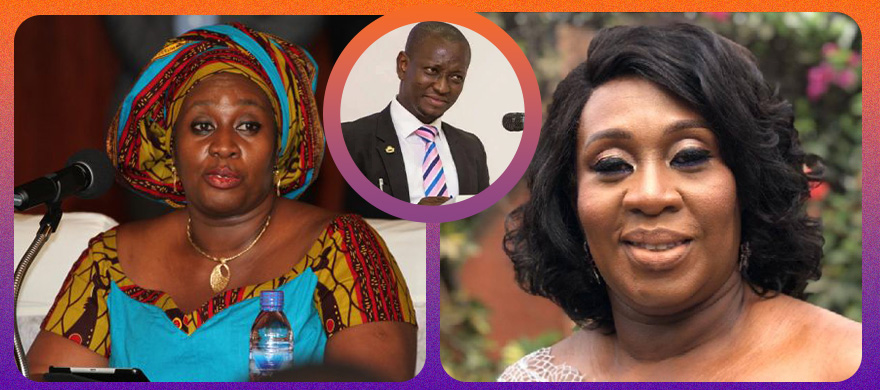
A three-member Court of Appeal panel unanimously acquitted and discharged former MASLOC CEO Sedina Tamakloe-Attionu on July 30, 2026, overturning her 10-year conviction just seven weeks after she was extradited from the United States to serve it. Justices Emmanuel Ankamah, Emmanuel Senyo Amedahe, and Samuel Obeng-Diawuo ruled the prosecution failed to prove its case beyond reasonable doubt.
The panel's 94-page judgment found that the trial judge shifted the burden of proof onto Attionu, undermining the constitutional presumption of innocence. Her lawyer, Enoch Deegbe, called the ruling "a victory for the rule of law."
How she ended up convicted without being in the country
Attionu was granted permission by the High Court in February 2021 to travel to the US for medical treatment while her 78-count corruption trial was ongoing. She never returned. The Financial and Economic Court 2, presided over by Justice Afia Serwaa Asare-Botwe, continued the trial in absentia.
On April 16, 2024, she was convicted and sentenced to 10 years' imprisonment with hard labour. Co-accused Daniel Axim, her former Operations Manager, received five years.
The extradition
Ghana filed a formal extradition request around July 2024. US Marshals arrested Attionu on January 6, 2026, in the Nevada/Texas area, and she was held at the Nevada Southern Detention Center. A US District Court in Nevada certified her extradition that April.
She was surrendered on June 8, 2026, and landed in Accra the next day aboard a United Airlines flight from Washington Dulles - the first successful US-to-Ghana extradition of a fugitive since 2009.
The 15-day gap that sparked controversy
Attionu received medical treatment at the Police Hospital after arrival. She wasn't formally admitted to Nsawam Medium Security Female Prison until June 24, 2026 - a roughly two-week gap between her return and the start of her sentence that drew public and political criticism at the time. What specifically caused the delay has not been officially explained.
Why this case sits differently from Ghana's usual corruption headlines
Most MASLOC-era corruption cases end one of two ways: a conviction that sticks, or a case that quietly stalls for years without a verdict. Attionu's case did neither - it produced a conviction, an extradition that took nearly two years to execute, and then an acquittal within seven weeks of her actually setting foot in a Ghanaian prison cell.
That sequencing is the story. Ghana rarely gets as far as physically retrieving a convicted fugitive from the US, let alone doing so only to see the Court of Appeal dismantle the case almost immediately after. It raises a genuine question for anyone tracking Ghana's other pending extradition files: does a hard-won extradition actually settle anything, or does it just move the legal fight to a different courtroom?
What happens next
The Attorney-General's office has directed the Director of Public Prosecutions to file a notice of appeal to the Supreme Court, alongside an application for a stay of execution of the Court of Appeal's judgment. The Attorney-General has said he is confident the acquittal will be overturned at the Supreme Court. Daniel Axim, out on bail since the Supreme Court granted it in January 2026, has his own appeal still pending - one that observers expect the Attionu ruling to influence. The Supreme Court's decision will determine whether the case closes for good or restarts the sentence Attionu has already briefly served.